For many engineering projects, choosing between 630 VS 631 stainless steel is crucial. 630 stainless steel is a popular choice because it is very strong and hard. The biggest difference between 630 VS 631 stainless steel lies in their special alloying elements and how they perform. Selecting the right stainless steel depends on your specific needs, such as strength, weight, or corrosion resistance.
| Factor | Stainless Steel 630 (17-4 PH) | Stainless Steel 631 |
|---|---|---|
| Density (g/cm³) | 7.78 | 7.93 |
| Key Alloying Elements | Nickel, Copper, Niobium | Nickel, Aluminum |
When deciding between 630 VS 631 stainless steel, engineers should carefully evaluate the requirements of their project to make the best choice.
Key Takeaways
- 630 stainless steel is very strong and hard. It works well for heavy parts. It is good for things that need high strength.
- 631 stainless steel fights rust better and can bend more. It is great for parts that must bend or not rust in tough places.
- Heat treatment makes both steels stronger and harder. It changes each one in a different way. 630 gets stronger as it ages. 631 needs more steps to get the best results.
- Picking 630 or 631 depends on what your project needs. Think about strength, rust resistance, bending, and cost.
- Use the guide and checklist to help you choose the right steel. Match the steel to your project, how you make it, and your budget for the best results.
630 vs 631 Stainless Steel Overview
Main Differences
630 and 631 stainless steel are both very common. They are types of precipitation hardening stainless steel. Both are strong and hard, but they are not the same. Their chemical makeup and how they act are different. 630 stainless steel is also called 17-4 PH. It has copper and niobium or tantalum. 631 stainless steel is also called 17-7 PH. It uses aluminum instead of copper. It also has more nickel than 630. These changes affect how each one works in tough places.
630 stainless steel gets very strong after heat treatment. It does not crack easily under stress. It works well in marine and factory settings. But it does not do as well in places with lots of acid or chloride. In those places, it can get small holes or cracks.
631 stainless steel is better at fighting rust. This is because it has more nickel and aluminum. It is also more stretchy. This makes it good for things that need to bend or handle high heat. The modulus of elasticity for 631 is about 200 GPa (29 ksi). This number is not usually listed for 630 stainless steel.
Note: Both 630 and 631 are precipitation hardening stainless steels. Their special mixes make them good for different jobs. Engineers should pick the one that fits their project best.
631 stainless steel can take more pulling force before it breaks. But 630 can handle more stress before it bends for good. 631 does better in lab tests for rust, especially in harsh or chemical places.

Quick Comparison Table
The table below shows the main differences between 630 and 631 stainless steel:
| Property | 630 Stainless Steel (17-4PH) | 631 Stainless Steel (17-7PH) |
|---|---|---|
| Chromium (%) | 15-17 | 16-18 |
| Nickel (%) | 3-5 | 6.5-7.75 |
| Copper / Aluminum (%) | 3-5 Copper | 0.75-1.5 Aluminum |
| Carbon (%) | 0.07 | 0.09 |
| Niobium + Tantalum (%) | 0.15-0.45 | N/A |
| Tensile Strength (MPa) | Up to 1200 | 1275 |
| Yield Strength (MPa) | 1172 | 1030 |
| Elongation (%) | 10 | 6 |
| Hardness (Rockwell C) | 40 | 41 |
| Density (g/cm³) | 7.75 | 7.80 |
| Modulus of Elasticity | Not typically reported | ~200 GPa (29 ksi) |
| Corrosion Resistance | Good, but less effective in acidic/chloride-rich environments | Enhanced, suitable for harsh environments |
| Typical Applications | Marine, industrial, valves, gears | Aerospace, chemical, food, cryogenic, springs |
- Both 630 and 631 are part of the same stainless steel family. But their special elements and how they act make them good for different uses.
- 631 stainless steel is better at fighting rust and is more stretchy. 630 stainless steel is stronger and easier to shape after heat treatment.
- Picking the right one depends on what you need. Think about if it will face rust, needs to bend, or must be very strong.
630 vs. 631 Stainless Steel Chemical Composition
Stainless steel 630 and 631 have different mixes of elements. This makes them work differently in factories and machines. Each one uses special elements to do certain jobs well. 630 stainless steel, also called S17400, has copper and niobium. 631 stainless steel, or S17700, has aluminum and more nickel. These changes affect how strong they are and how they handle heat or rust.
The table below lists the main elements in both stainless steels by ASTM rules:
| Element | Stainless Steel 630 (S17400) | Stainless Steel 631 (S17700) |
|---|---|---|
| Carbon (C) | ~0.07% | ~0.09% |
| Chromium (Cr) | 15.0-17.5% | 16.0-18.0% |
| Nickel (Ni) | 3.0-5.0% | 6.5-7.7% |
| Manganese (Mn) | ~1% | ~1% |
| Copper (Cu) | 3.0-5.0% | None |
| Columbium + Tantalum (Cb+Ta) | 0.15-0.45% | None |
| Aluminum (Al) | None | 0.75-1.50% |
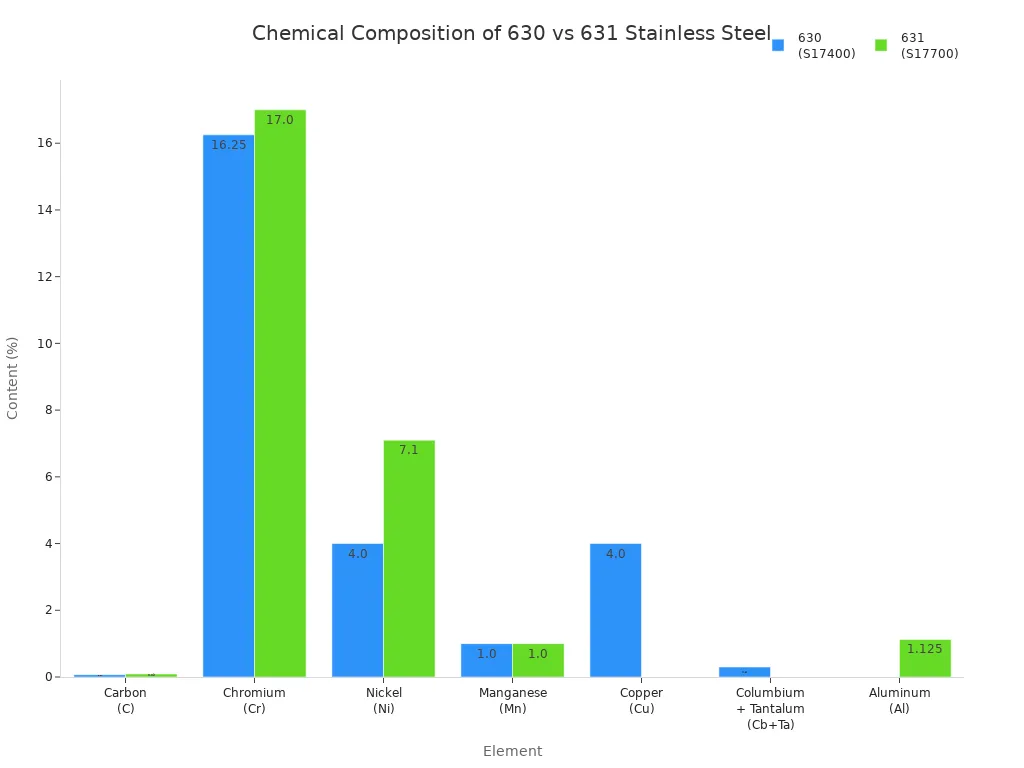
Stainless steel with more chromium and nickel, like 631, fights rust better. It can also bend more without breaking. 630 stainless steel has copper and niobium, which make it stronger and more steady. This is good for heavy parts. Even small changes in the mix can change how tough or reliable the steel is. Factories must watch the mix closely to make sure the steel is good enough for use.
Note: The right mix of elements helps stainless steel work well in hard jobs like planes, cars, and medical tools. Controlling things like chromium, nickel, copper, and aluminum helps the steel last longer and stay strong.
630 Stainless Steel Properties
Key Properties
Type 630 stainless steel is also called 17-4 PH. It is a precipitation hardening stainless steel. This steel is very strong and hard. That is why engineers use it for tough jobs. It does not rust easily, much like 304 stainless steel. It works well in places up to 300 °C (600 °F). If you overage the steel, it fights stress cracks better. This helps parts last longer in rough places.
Engineers like this alloy because they can change it with heat. They use heat treatment to make it harder or stronger. This lets them pick what works best for their job. The table below shows how heat changes the steel’s strength and hardness:
| Condition | Ultimate Tensile Strength (psi) | Hardness (Rockwell C) |
|---|---|---|
| H900 | 190,000 | C40 |
| H1025 | 155,000 | C35 |
| H1075 | 145,000 | C32 |
| H1150 | 135,000 | C28 |
| H1150-M | 115,000 | C24 |
| H1150-D | 125,000 | C24 – C33 |

Note: Precipitation hardening stainless steel like 630 is strong, hard, and resists rust. These features make it good for important parts.
Applications
Many industries use 630 stainless steel for its special features. The aerospace industry uses it for turbine blades and fasteners. It is also used for pump shafts because it is strong and does not break easily. Chemical plants use it for valves, pumps, and heat exchangers. This is because it does not rust much. Marine engineers use it for boat shafts, fittings, and engine parts. It works well in seawater.
The table below lists common uses and reasons for picking 630 stainless steel:
| Industry | Reasons for Selection and Applications |
|---|---|
| Aerospace | High strength, fatigue resistance, lightweight parts |
| Chemical Processing | Good corrosion resistance, reliable in valves and pumps |
| Marine | Good corrosion resistance in seawater, durable parts |
| Nuclear | Strength and stability at high temperatures, reactor components |
| Oil & Gas | High strength for deep-sea piping, resistance to hydrogen sulfide and poor pH |
| Food Processing | Good corrosion resistance, easy to clean, durable equipment |
| Automotive | High strength, lightweight, used in exhaust systems and fasteners |
Precipitation hardening stainless steel like 630 is used in oil field tools, gears, and motor shafts. Its mix of strength, hardness, and rust resistance makes it great for tough jobs in factories.
631 Stainless Steel Properties
Key Properties
631 stainless steel is also called 17-7PH. It is known for being very strong and hard. When you heat treat it the right way, it gets even harder. Two steps of heat treatment can make it as hard as HRC40. This steel does not bend or change shape easily, even when it gets hot. Engineers like that it can stretch and go back to its shape. This makes it great for parts that need to bend and spring back. In spring tests, it has a K value of 1.1 kg/mm. This shows it is good for making springs. It also does not rust easily, even in tough places. Just heating it once does not change it much. But the right heat treatment makes it work its best. These things make 631 stainless steel a good pick for hard jobs.
Note: 631 stainless steel is strong, hard, and stretchy. It also fights rust and does not bend easily. These things make it good for important machine parts.
Applications
Many companies use 631 stainless steel for lots of things. Its strength and toughness help in building frames and big machines. Because it can bend and spring back, it is used for springs and bendy parts. Many jobs need this steel because it lasts long and works well under stress.
| Product Type | Common Applications in Manufacturing and Construction |
|---|---|
| 631 Stainless Steel Strip | Used for strong frames and heavy machines because it is tough and lasts long |
| Stainless Steel Bars | Used in building, making things, and factories; includes many shapes like angle, flat, round, and more |
| Stainless Steel Pipes | Used in building, plumbing, oil and gas, chemical plants, and for looks; comes in many shapes like round, square, and rectangle |
| Stainless Steel Sheets | Used in building, filters, floors, stairs, and factories; includes plates with holes or patterns |
Engineers pick 631 stainless steel for parts that must bend and handle heat. Its features help in planes, cars, and chemical machines. Because it is strong, hard, and does not rust, it works well for a long time in hard places.
Mechanical Properties Comparison
Strength and Hardness
Engineers look at 630 and 631 stainless steel to pick the best one. Both are strong, but their hardness is not the same. Hardness is tested in two ways. The Brinell test checks how wide a dent is. The Rockwell test checks how deep a dent goes.
| Stainless Steel Grade | Brinell Hardness Range | Rockwell C Hardness Range |
|---|---|---|
| 630 (UNS S17400) | 280 to 440 | 27 to 43 |
| 631 (UNS S17700) | 180 to 430 | 41 to 46 |
630 stainless steel starts out harder than 631 on the Brinell scale. But 631 can get harder than 630 on the Rockwell scale. This changes how each one works in real life. 630 stainless steel stays strong and hard after heat treatment. 631 stainless steel can be softer or harder, so it is good for jobs that need both bending and strength.
Elasticity and Deformation Resistance
Elasticity is how much a metal can bend and snap back. The elastic modulus tells us how stiff the metal is.
| Stainless Steel Grade | Elastic Modulus (GPa) |
|---|---|
| 630 | 196 |
| 631 | 204 |
631 stainless steel is a little stiffer than 630. This means 631 does not bend as much under force. It also goes back to its shape better. That is why 631 is great for springs and parts that must flex. 630 stainless steel is still elastic, but it is made more for strength and staying steady.
Note: Things like elasticity and how well a metal keeps its shape help engineers pick the right steel for moving parts.
Corrosion Resistance
Corrosion resistance means how well the metal fights rust. Both 630 and 631 stainless steel do a good job against rust. 631 stainless steel has more nickel and aluminum, so it fights rust better in tough places. It works well in chemical plants and wet areas. 630 stainless steel also resists rust, but it can get small holes or cracks in acid or salty places.
How long the steel lasts depends on where it is used and how it is treated. Both types do not crack easily from stress, but 631 usually lasts longer in harsh spots. Engineers should pick the one that matches their project’s needs.
630 vs. 631 Stainless Steel Heat Treatment
Heat treatment is very important for both 630 and 631 stainless steel. It helps make the steel stronger, harder, or more bendy. Each type of steel changes in its own way when heated. Engineers use heat treatment to get the right features for each job.
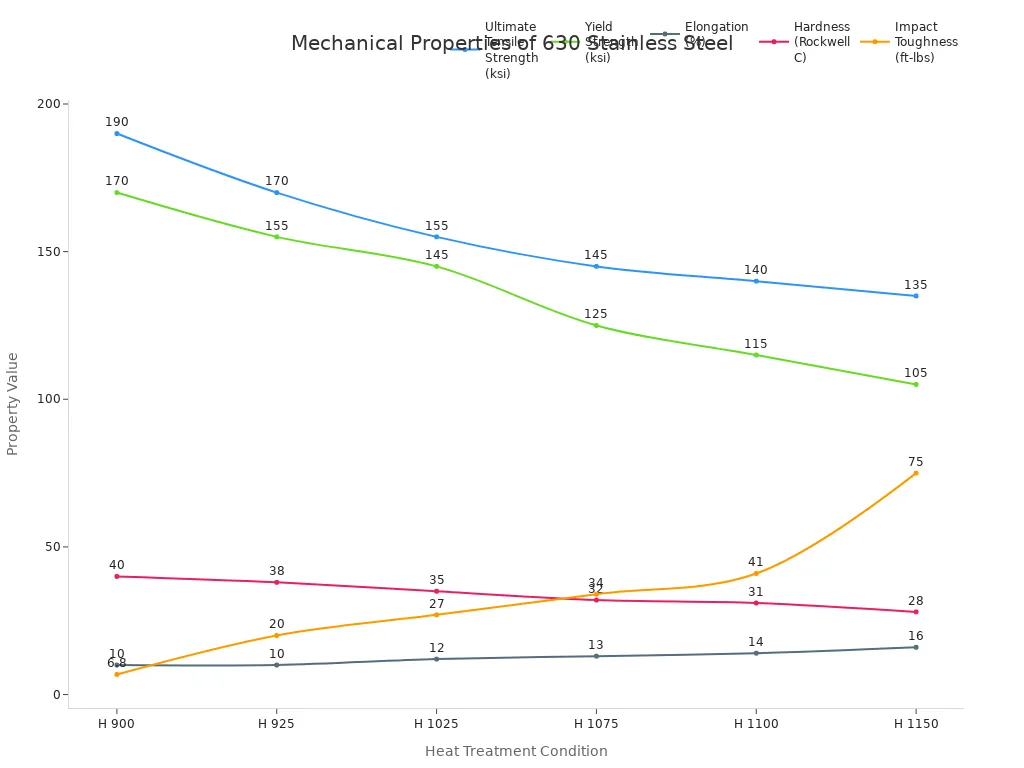
630 stainless steel is also called 17-4 PH. It goes through two main steps. First, it is heated to about 1040°C. Then it cools down in air or oil. After that, it is heated again at lower temperatures, between 900°F and 1150°F. This second step is called aging. Aging changes how strong, hard, or tough the steel is. If you use a lower aging temperature like H900, the steel gets very strong and hard. If you use a higher temperature like H1150, the steel gets easier to bend and less hard.
The table below shows how different heat treatments change 630 stainless steel:
| Heat Treatment Condition | Ultimate Tensile Strength (ksi) | Yield Strength (ksi) | Elongation (%) | Hardness (Rockwell C) | Impact Toughness (ft-lbs) |
|---|---|---|---|---|---|
| H 900 | ~190 | ~170 | 10 | 40 | 6.8 |
| H 925 | ~170 | ~155 | 10 | 38 | 20 |
| H 1025 | ~155 | ~145 | 12 | 35 | 27 |
| H 1075 | ~145 | ~125 | 13 | 32 | 34 |
| H 1100 | ~140 | ~115 | 14 | 31 | 41 |
| H 1150 | ~135 | ~105 | 16 | 28 | 75 |
631 stainless steel is also called 17-7 PH. It uses heating and cooling steps called annealing and tempering. These steps make it stronger and help it bend without breaking. Heat treatment also helps it fight rust better. This makes 631 stainless steel good for things like wires and machine parts that need to last a long time.
Tip: Picking the right heat treatment helps engineers get the best mix of strength, toughness, and bending. Always choose the process that fits the job.
630 vs. 631 Stainless Steel Corrosion Resistance
Corrosion resistance is very important when picking stainless steel for tough places. Both 630 and 631 stainless steel can fight rust, but they do not work the same. This is because their chemical makeup is different, so they react differently in harsh spots.
630 stainless steel, called 17-4 PH, does a good job fighting rust in many factories. It works well with water, steam, or weak chemicals. But if there are lots of chlorides or acids, it can get tiny holes or cracks. In the ocean, 630 stainless steel can stop rust, but it might not last as long as other types in salty water.
631 stainless steel, or 17-7 PH, is even better at stopping rust. It has more nickel and aluminum, which helps it fight rust in chemical plants or places with strong acids. This steel does better than 630 in wet or damp places. Many engineers use 631 stainless steel for springs, filters, and parts that get wet or touch chemicals a lot.
Tip: Always pick stainless steel that matches the place it will be used. For jobs in strong chemicals or the ocean, 631 stainless steel usually works best.
The table below shows how well each type fights rust:
| Alloy | Corrosion Resistance Level | Best Use Environments |
|---|---|---|
| 630 (17-4 PH) | Good | Freshwater, mild chemicals, steam |
| 631 (17-7 PH) | Enhanced | Saltwater, acids, humid air |
Engineers need to think about what kind of rust their project might face. Things like pitting, cracks, and stress from rust can make a part break sooner. 631 stainless steel protects better in most tough places. 630 stainless steel still works well for less harsh jobs.
630 vs. 631 Stainless Steel Fabrication
Making things from 630 and 631 stainless steel is important. Each type acts differently when you cut, bend, or join it. People who build things need to know these differences to do a good job.
Machining
630 stainless steel is also called 17-4 PH. It is easy to cut when it is soft. After you heat it, it gets much harder. This can make cutting tools wear out fast. Workers use slower speeds and strong tools to help. 631 stainless steel is also called 17-7 PH. It is harder to cut because it is stronger and more stretchy. Using sharp tools and steady moves helps stop tools from wearing out.
Forming and Shaping
It is best to bend 630 stainless steel before it gets hard. When it is soft, it bends and shapes easily. After heat, it gets stiff and can crack if you bend it. 631 stainless steel is great for bending and shaping. It can bend and stretch without breaking, even after heat. This makes it good for springs and parts that need to move.
Welding
You can weld both types, but you must be careful. 630 stainless steel welds well when it is soft. After welding, you need to heat it again to make it strong. 631 stainless steel is harder to weld. Its strength and stretchiness can cause cracks. Heating before and after welding helps stop cracks.
Finishing
Both types can be polished and finished. 631 stainless steel often looks smoother because of its tiny grains.
Tip: Pick the right way to make each type. Good planning saves material and makes better parts. 🛠️
The table below shows the main points for making things:
| Process | 630 Stainless Steel (17-4 PH) | 631 Stainless Steel (17-7 PH) |
|---|---|---|
| Machining | Easier when soft | Harder, wears tools |
| Forming | Best before hardening | Great, even after hardening |
| Welding | Good with heat after welding | Hard, needs special care |
| Finishing | Good, may need more polish | Smooth, fine look |
People who build things should use the right ways for each type to get the best results.
Applications in Industry
Industrial Uses
Engineers pick 630 and 631 stainless steel for many jobs. In oil and gas, 630 stainless steel is often the best. It is strong and does not crack from stress. People use it for valves, pumps, and drilling tools. In aerospace, 631 stainless steel is a favorite. It can bend and snap back without breaking. This makes it good for springs, fasteners, and parts that face a lot of force. Car makers use both types. They use 630 stainless steel for gears and shafts that must stay strong. They use 631 stainless steel for parts that need to bend or return to shape, like springs.
| Industry | Preferred Alloy | Main Reason for Use |
|---|---|---|
| Oil & Gas | 630 | Strength, stress-crack resistance |
| Aerospace | 631 | Elasticity, high-temperature use |
| Automotive | Both | Strength (630), Flexibility (631) |
| Medical Devices | 631 | Bio-compatible, surgical use |
Note: The best alloy depends on the job. Engineers think about strength, bending, and how the metal handles chemicals.
Medical-Grade Stainless Steel
Hospitals and clinics need safe metals for tools and machines. 631 stainless steel is a top pick for medical use. It is safe for the body and does not rust. Doctors use it for tools and implants. Its strength and ability to bend make it great for bone plates and screws. Makers also use 631 stainless steel for sharp, clean tools.
Doctors trust medical-grade stainless steel for many things. It is safe to use inside the body. Bone doctors use it for implants that help bones heal. Surgery teams pick it for tools that must be strong, easy to clean, and safe. 631 stainless steel is better than 630 for most medical jobs.
Tip: Always make sure the alloy is safe for the body before using it for implants or tools.
630 vs. 631: Choosing the Right Stainless Steel
Decision Guide
Picking the right stainless steel is very important. Engineers need to match the alloy’s features to what the project needs. Here is a simple step-by-step guide to help you choose:
- Define the Project Environment
First, find out if the project will face water, chemicals, salt, or heat. 631 stainless steel is best for tough, wet, or salty places. 630 stainless steel works well where things are not as harsh. - Determine Required Strength and Hardness
If you need something very strong and hard, pick 630 stainless steel. It gets even tougher after heat treatment. If the part needs to bend or spring back, 631 stainless steel is better because it is more flexible. - Assess Corrosion Resistance Needs
If the job will face acids, salt, or wet air, 631 stainless steel is a good pick. It has more nickel and aluminum, so it fights rust and pitting better. - Consider Fabrication and Forming
630 stainless steel is easier to cut and shape before it gets hard. After heat, it is harder to bend. 631 stainless steel can still be shaped even after it is hard, so it is great for springs and bendy parts. - Evaluate Cost Constraints
The price matters too. 631 stainless steel costs less than 630 stainless steel. The table below shows their prices:Stainless Steel GradePrice (USD/KG)630 Stainless Steel6.85631 Stainless Steel4.15Using 631 stainless steel can help save money on big projects. - Review Expert Recommendations
Experts say 630 stainless steel is best for important jobs that need to be strong and safe, like airplane parts and medical tools. 631 stainless steel is great for boats and parts that need to fight rust and have magnetic features.Stainless Steel GradeKey PropertiesRecommended ApplicationsExpert Recommendations17-4 PH (AISI 630)High strength, hardness, corrosion resistance, durability; can be enhanced by heat treatmentAerospace components, medical devices, mechanical parts requiring balance of strength and corrosion resistanceRecommended for critical engineering applications needing structural integrity and reliability; versatile in precision casting17-7 PH (AISI 631)Superior corrosion resistance (better than SS316 and SS304), precipitation hardening for strength and durability, magnetic propertiesMarine environments, high-stress precision-cast partsIdeal for applications demanding enhanced corrosion resistance and strength under stress; magnetic properties add versatility
Tip: Always pick the alloy that is best for the hardest job your project will face. This keeps things safe, works well, and saves money.
Checklist
Before you decide, use this checklist. It helps make sure the stainless steel you pick is right for your project:
- Strength:
- Does your project need to be very strong and hard?
- 630 stainless steel is stronger after heat treatment.
- Elasticity:
- Does the part need to bend or go back to its shape?
- 631 stainless steel is better for bending and springs.
- Corrosion Resistance:
- Will the metal face acids, salt, or wet air?
- 631 stainless steel fights rust best.
- Fabrication:
- Does your design need lots of bending or shaping?
- 631 stainless steel is easy to shape after it is hard.
- 630 stainless steel is easier to cut before heat.
- Cost:
- Is saving money important?
- 631 stainless steel is cheaper than 630 stainless steel.
- Application Fit:
- Is your project for planes, medicine, or boats?
- 630 stainless steel is good for strong, important parts.
- 631 stainless steel is best for boats and tough jobs.
✅ Quick Review:
Go through each point above to make sure the alloy fits your project. Ask an expert if your job is tricky or very important for safety.
By using this guide and checklist, engineers can pick the right stainless steel for any project.
630 stainless steel is very strong and hard. This makes it good for heavy parts. 631 stainless steel fights rust better and can bend more. That is why it works well for springs and medical tools. Engineers must pick the alloy that fits what their project needs. If the job is tricky or very important, they should ask a materials expert for help.
Tip: Check the decision guide above to choose the right stainless steel. Picking carefully helps your project last longer and work well.
FAQ
What is the main difference between 630 and 631 stainless steel?
630 stainless steel gets stronger and harder after heat treatment. 631 stainless steel bends more and fights rust better. Each one is good for different jobs because of these features.
Can both 630 and 631 stainless steel be welded?
You can weld both types. 630 stainless steel is easier to weld when it is soft. 631 stainless steel needs careful heating so it does not crack.
Which stainless steel is better for marine environments?
631 stainless steel is better at stopping rust in salty water. It works well in places with lots of water and chemicals.
Are 630 and 631 stainless steel magnetic?
Both types can be magnetic after heat treatment. 631 stainless steel is often more magnetic, especially after it is worked or aged.
How does heat treatment affect 630 and 631 stainless steel?
Heat treatment makes both types stronger and harder. 630 stainless steel gets better with aging. 631 stainless steel needs more than one heat step to work its best.